Saturday, April 30, 2011

Beyond the Reef


1.) The Great Barrier Reed is considered the "largest living structure on earth".
2.) Coral extracts Calcium Carbonate (CaCO3) from the surrounding waters to make solid tentacles.
3.) Red Algae could be considered the "glue" of the ocean, it cements fragments of shells, sand, and coral with sheets of CaCO3. It is responsible for much of the construction of the Great Barrier Reef.
4.) The Great Barrier Reef was established as a National Park in 1975.
5.) 33% of the Reef is protected from fishing.
6.) Scientists believe the current Reef is about 20,000 years old, although Geologists have found evidence of ancient corals believed to be half a million years old!

Are we trapped behind the lenses?

    
My aunt from behind the lenses while we
were touring the desert outside of Dubai


        While reading a reflective article, "Savor the Trip, Don't Tweet It" by Christopher Elliot, I actually found myself quite guilty of the things he was bringing out into the open. Elliot very generally points out the reality that we are living in a time where technology is openly available - everyone uses it. He makes the article less accusatory by also stating he and his family have also found themselves guilty of being engrossed in technology instead of the environment they were surrounded by, you're on vacation after all, who knows when this opportunity will arise again. By sharing his own personal experiences, I believe Elliot is trying to get to the reader to understand that technology doesn't need to run your travels. We aren't living in a Transformers movie,neither your phone, iPod nor laptop will suddenly transform into a robot and take control of you. It is by our own will that we allow ourselves to succumb to our technological desires, but by taking a break from it- we can learn to appreciate its absence.

       On this journey to Australia and New Zealand, I want to be absorbed, immersed; not into my friends' latest Facebook update, or the music playing from my iPod, but into the trip itself. Just I said before in response to Pico Ayer, we need to see with new eyes and take in every detail, use all our senses to live in the moment. That's not possible, when you're looking through the lens at the moment. As Don Mankin stated in Elliot's article "Instead of having the experience, you are now observing yourself having the experience. It's a layer removed and its just not as sensual." Those words couldn't be more true. It's great to document the experience, and have things to remember it by--as long as those things mean something to you and will continue to hold significance rather than if you were to pack it away and forget about it.
       Pico also brought up a point that I believe is relevant to Elliot's theme, the idea that fear gives value to travel. Fear is a driving force, that can push us to do unexpected things we might have not had the courage to do previously. Courage can only exist with the presence of fear, after all. On this trip, we must leave our fears behind. The fear of not being able to check our Facebook every hour. The fear of not being able to text friends. The fear of the unfamiliar. I've come to the realization I may never have this opportunity again and I want to do everything I can to make it worthwhile. I am going to loosen technologies tight grasp, I will bring my cell phone on this trip, solely because I used it as my iPod, but its use will be very limited. I will only use it to listen to music on the plane rides and in the hotel room, but that is the extent of its usage. I'm giving up Facebook altogether, I know for a fact it's going to be nothing but a burden. As for my camera- my one true love, it will be difficult but I plan on reducing the amount of video and photos I take by quite a bit. My goal is to take no more than 20 photos a day. That's a limit of 252 photos the entire trip, which will force me to only capture the moments that have the most significance to me personally. This isn't going to be me looking at my trip from among the mass of pictures. This is going to be me living the journey - each and every day, not from behind the lenses, but with new eyes.

Wednesday, April 27, 2011

History of the Human Condition

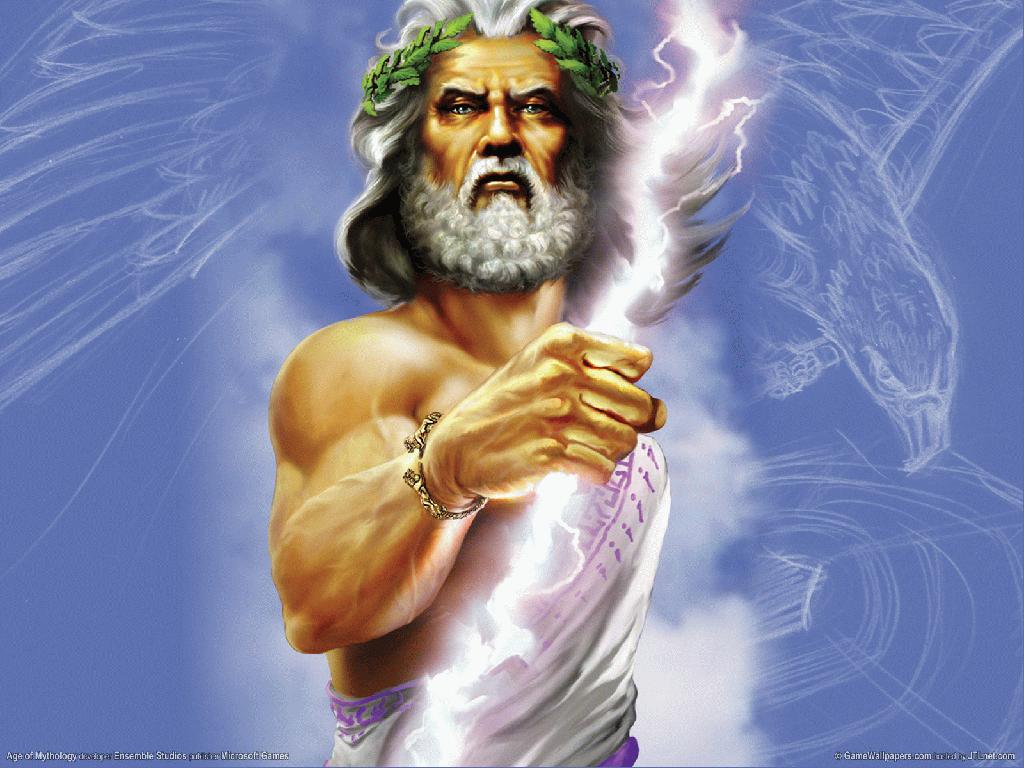
Zues: A famous figure in Greek mythology, a prime example of  
modern myth still shared  and kept alive.
We, as humans, have an undying thirst for knowledge of the unknown, a never ending supply of questions about everything that exists - or what is believed to be. Essentially, we are born in an abyss of ignorance and as we grow and evolve, we delve deeper into the abyss, we were not made to dwell in darkness, however. We are all in heavy pursuit of something greater. The pursuit of happiness. The pursuit of knowledge. The pursuit of freedom. And this endless pursuit is what gradually unveils the cloud of ignorance. This is the human condition. This pursuit is strengthened and kept alive by the existence of myths and creation stories, made to answer questions every human being asks such as "Why am I here?", "How did I get here?", "What is my purpose?", we rely on these myths and stories to fill in the blank spaces void of scientific explanation. These "myths" are more important than people may realize and they're all around. The Bible, for instance, dates back to the start of life, guidelines for a heightened self awareness and better life. And then, of course, are the stories we grew up with; Paul Bunyan, Johnny Appleseed, Greek Gods. Legends, stories and myths are necessary to maintain a strong culture, they need to be passed down and kept alive for those living in the present to know about where they and things around them originated. There are some things that can't be justified; proven, and that leaves us to trust what we believe. To trust the existence of the nonexistent.
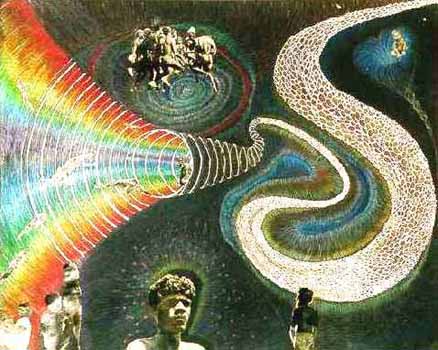
A portrait of the Aboriginal "dreamtime", heightened awareness and
connection of all living beings and earth
  The Aboriginal and Maori cultures have very creative and distinct values and beliefs when it comes to how their culture originated, although the stories have clear differences, they have a similar overall theme. Both stories hold deep significance in the structure of family and environment, both stories are based on an abundant amount of Gods, all being related, stress the importance of roles of  each member of the family. The Maori myth, for example, signifies complete trust in each member of the family, so that dishonesty and trickery against one another doesn't arise. Family should not turn on one another, no matter the extremity of the situation. The Aboriginal myth also stressed the importance of trust in one another, for example, when the living creatures of the earth saw the sun leave and feared she had abandoned them but when she reappeared "the children learned to expect her coming and going and were no longer afraid" because they trusted her. The Aboriginal myth also stressed the importance of living peace alongside family, so trivial matters such as greed and envy can be overcome. Although the stories do have the same general theme of the importance of family, the stories do differ when it comes to the "higher power" or center of the story. The Maori represent a strong relationship between the earth and human kind, humans being the superiors of the earth, exalted above animals, being the only early creatures mentioned to inhabit the earth at the time. This story focused more on social relationships and human interaction with one another and the effect it has on the earth, our actions directly effect our planet, the story seems to be void of environmental significance. The Aboriginal myth however, portrays a circle of life between all inhabitants of the earth and the earth itself, the sun being the mother of all life. The sun's presence stimulates growth in the environment and the creatures, who must work together to please the sun mother. The Aboriginal myth has a strong sense of environmental importance as well as social relationships. 


In today's high-tech, advanced society, it seems there is no need for these "myths" and "stories", after all, we have endless scientific evidence to back it up and explain everything. Right....and wrong. Science can only explain so much, there are, undoubtedly, unexplainable happenings that we as humans seek a reasonable explanation for, and when science falls through, the stories that have existed for generations seem to aid us with their different perspectives on the way things are, but it seems society is quick to outgrow these "childish" stories. It reminds me of when I was younger, stories of Santa and his elves, and the water and carrots I would leave outside for the reindeer. Santa was the only logical explanation for the presents left under the tree the next morning, but I soon outgrew this belief, because like most people I sought out the truth, but I never truly "outgrew" this story. There is something deeper in these myths and stories - there are morals and lessons behind them, I learned the importance of giving for the sake of giving, to not expect anything in return, the importance of friends and family, and compassion. This is what the ancestors of the Aboriginal and Maori have left behind for us in these stories - lessons for the present and the future, the presence of environmental involvement in these stories may signify that we need to treat our environment with the utmost care, in an almost sacred manner, we may be superior beings, but with that comes power, the power to change the earth - the Maori and Aboriginals believe we can change it for the better, but because the world today is not as in tune with stories and culture such as these, our environment has become a business deal, something to make money off of, not something to cherish and protect. Which brings us back to the importance of family structure. Without compassion, trust and discipline, trivial matters such as greed and violence which are always present, but can be controlled, can spiral out of control.

 Creation "stories" are still ever present and I am an avid believer of one myself. The Bible keeps me rooted to my beliefs and the way I treat others and look at the world around me. My faith has led me through struggles and taught me that the obstacles that I encounter are not meant to knock me down, but to help me build resistance against them so I can overcome them. As a Christian, I have accepted the fact that I am not perfect and never will be, but I am made exactly the way I am for a reason, and my faith has helped me accept myself and others' differences. Because I know I am not perfect, and can strive to be the best that I can, and accept and learn from the mistakes I make along the way because I know it will only strengthen me. Having faith in God has taught me to believe in everything I do, no matter how insignificant because I know I am never alone. The way I treat others also directly attributes to my beliefs, I just remember that the way I treat others is the way I treat God, so everyone deserves respect, differences aside, because in the end, we are all part of life's creation story.

Saturday, April 16, 2011

A Glance into the Past, Three Countries' Journey to the Present


We live in a big world. Albeit, with the ever growing modern technology we possess, it seems to be growing smaller, but it's still the same size it's always been. It's history, however, is tremendously colossal and significant, the earth's modern day humans having been bustling about for around 200,000 years. And they've left behind immalleable footprints. Some such footprints withhold similar significance and history behind them, such as those of the Aboriginal Australians, New Zealand's Maori, and early American settlers. In order to fully appreciate a country in its present state, you must be cognizant of its past. A tree cannot grow without its roots firmly planted. A driver cannot not drive without glancing at the rear view mirrors. We, as people cannot understand the present nor embrace the future without glancing into the past.
               Around 1770 A.D for all three (present) countries underwent a period of exploration and discovery by the Europeans, three unknown lands with much to offer and learn about. After a long treacherous sea-faring journey, British navigator, James Cook arrived in New Zealand in 1769, welcomed by the land's harsh beauty. Cook documented profusely in journals of his discovery, and upon the arrival in New Zealand, he wrote "The land on the Sea-Coast is high with steep cliffs, and appeares to be cloathed with wood and Verdure". These precious journals he kept inspired other Europeans to also explore this extraneous land. A year later, James Cook ventured to Australia and claimed it as New South Wales, the first of six colonies in 1788. At this time in America, rebellion was stirring in the form of the Boston Tea Party and the publication of The Intolerable Acts, America was striving to find itself, to unite itself, thus the 13 colonies were created. Much similar to Australia perhaps, 11,000 miles away both America and Australia were transforming into the strong nations they are today. 
Having been continuously productive and ambitious, the Europeans were on a conquest for domination, even if it meant hurting others in the process. Thus, creating similar signifigant controversy in America. 1838, the year the Cherokee walked the Trail of Tears, and as a result many died on the treacherous walk. The Europeans saw no benefit from colonizing the Americas with the Native culture still present, so they brutally forced the Native Americans onto reservations, out of sight, out of mind. New Zealand and America may have been completely different countries, but they were suffering together. There is, however a brighter side to this past. The Gold Rush of 1850-1860 couldn't be a more perfect representative of opportunity and wealth, and all three countries had the chance to experience it. In Australia, whole settlements up and left in search of gold. In New Zealand, gold was discovered in Tuapeka, and indeed a gold rush ensued. In America, an event that would forever mark the history books, The California Gold Rush, which brought approximately 200,000 "forty-niners" to California in search of gold! Unfortunately, many returned home empty-handed, and many Native Americans in California at the time died because of this sudden immigration, but the Gold Rush undoubtedly changed American, New Zealand, and Australian History in its effects.
      The 1900s was a time of independence, unity and self-discovery for these countries, and all three have battle wounds to show the previous struggle. Early in the century, Australia's 6 colonies have been conjoined to create The Commonwealth of Australia in 1901. Just 6 years after, New Zealand becomes a dominion within the British Empire, and are on their way to independence, which they later receive in 1947. 1955-1962 was a critical time period of signifigant movement towards equality for both Australia and America. America was introduced to one of the world's most profound leaders, Martin Luther King Jr and the dream he had for the future of America, a future of colorless prejudice, and through him, African Americans gained the equality they should've always had. For the Aboriginals, they were given the right to vote and in 1967 they were recognized as citizens of Australia. The Aboriginals made leaps and bounds after that, in 1976, the Aboriginal Land Act was passed, allowing them to make claims on ancestral land.Both of these feats represent how far having a dream can take a person, or in fact, a nation. All three countries had a dream, and acting upon that dream, they achieved what they had hoped for, separately, yet together. Even today, these countries continue to grow and achieve, the long-awaited formal apology was finally given to the Aboriginal people by the Australian Parliament in 2008.
.
"Australia" my all-time favorite movie, which is actually about 
the Stolen Generation and the Aboriginal culture
during World War II.

I have never been to Australia or New Zealand,they are both foreign and unknown to me,  but by learning their history and comparing it with the history of my nation, I will come to realize, despite our differences, we all struggle together, we feel the same emotions, we live on the same earth and we all have to carry our pasts with us -always.


Sources: