Friday, June 17, 2011

Day 10 - Going Home

Our last sunset in Cairns


Sadly, all things must come to an end. We woke bright and early - 3:30 to be exact and we said our sad goodbyes to Mrs. Titus (we miss you a lot, if you're reading this!) Then, we arrived at the airport and went through the routine we were all now very familiar with, of checking our bags, getting ready to depart, we were exhausted but we managed to stay alert enough to at least get onto the plane with no problems. From Cairns to Sydney, I dozed on and off, even though I was intent on finishing The Hunger Games, sleep was inevitable. On the flight from Sydney to LAX, however, I didn't sleep at all. I sat next to Bridget and we talked for a while, and I watched a lot of movies, including Tangled (such a funny movie, I reccomend it!) The highlight of this flight was the insane turbulence! We were going through a storm and I have been on planes literally hundreds of times and never felt this much turbulence before, we were being rocked violently side to side and at some point we dropped 20 to 30 feet at a time, it was crazy! Some of us put our hands up and screamed a bit, some held hands, some closed their eyes trying to keep calm, some prayed. I listened to music. Adele has a very soothing voice. Thank you Adele, for keeping me calm. It's nice to be back home, but every day I feel this longing to go back, I'm sure it'll never fully go away. I'm sure it's more than just the longing to go back to these two beautiful countries, it's the longing of travel. Every time you immerse yourself in a new country, I feel that the urge becomes stronger. One day, I will travel the world and Australia and New Zealand have brought me two steps closer. I'll never forget this trip. Thank you to everyone who made it happen, my parents, my teachers, my peers, you made this trip unforgettable.

Thursday, June 16, 2011

Day 9 - Kuranda


Even though today was our last day, we made the most of it in a pleasant, beautiful, little town called Kuranda. It felt like we were going back in time to the Wild West, the sun was shining, the sky was a perfect blue, birds were chirping and the grass was swaying. We're waiting at the train tracks and then this train unlike any other I've seen pulls up and the first three cars and covered top to bottom in Aboriginal symbols and  illustrations with many bright colors and designs, it was beautiful. Then, the rest of the train looked like an old westernized train, it was so quaint. On the inside, there were rows of big, long seats facing each other, the ride up the mountain was so peaceful and pleasant with the windows open, warm air blowing in your face, a few times some of us dozed off with smiles on our faces. We passed waterfalls and huge mountains and forests, you'd hear "ooohs" and "ahhhhs" constantly. Some of the scenery was too beautiful to even capture on camera, especially the waterfalls, I have the mental image engraved in my mind, the sight, the sound, the movement of the water, it's something you have to see with your own eyes. We then arrived in the cute, little town of Kuranda full of little eateries and shops with handmade and authentic clothing and trinkets, you could see the Aboriginal influence in everything. After some shopping and eating we took a short tour through the rainforest, saw some of the oldest and tallest trees in the world, and learned a lot about the nature of the rainforest.


 Afterwards, we got to see Aboriginal creations stories and performances, they were amazing. The Aboriginals would re-enact and imitate animals, like kangaroos, and for a moment you feel as if you really are looking at an animal, not a person. After the shows, we learned how to throw boomerangs and spears! It is a LOT harder than they make it look, but after that, I am determined to hone my skills, so when I visit Australia again (and I will), I can show them I can do it too!

Top 10 in Australia and New Zealand:


1.) The Great Barrier Reef - It was so breath-taking seeing all this underwater life up close and personal, and seeing the way every species cohabitated with one another. It really puts the environment in perspective for you, it makes you want to strive to protect something so beautiful.

2.) Rangitoto College - These kids changed my life in just a few hours. I never would have expected to have such a close, rapid connection with people who live on the other side of the earth, with a different culture, being complete strangers, they were still teenagers, and it really taught me that no matter where you come from, we're all still the same. We're all still capable of loving one another. They were so kind. I actually cried as we drove away from the school.

3.) Rotorua - Despite the rotten smell, this town was so beautiful and so rich with history and culture, it really made you appreciate their values and lifestyle. I got to see what was probably the most beautiful sunrise...ever, one morning in this beautiful town. I also met some really friendly people locally here, like the waitor, Leighton, at the burger restuarant.

4.) Whakarewarewa-  I just absolutely fell in love with the Maori culture. I've never been into a village that's still inhabited with the native culture, and it was really amazing to see the beauty and really learn about the lifestyle of the Maori, currently and about their history. The thermal springs and geysers were a real beauty to see too.

5.) Cairns - This small town was so cute and even though we were only here for a short time, I loved it. I can't believe it was winter, it was 80 degrees and sunny, we got to go the pool and shop around. It felt like a summery town, so easy going and laid back, the people were also so friendly. On our last day, we experienced a gorgeous sunset.

6.) The Sydney Bridge - Wow. What was supposed to be maybe a 20 minute climb was around 3 hours, the view of Sydney from so high above was absolutely amazing. I'm not afraid of heights, but we were really high, it was insanely windy, but that didn't stop us. We took pictures, laughed, admired the aerial view, it was definately a worthwhile experience. My legs were so sore afterwards though.

7.) Luging - Not many people could say they've done something like this. Go - carting down a mountain in New Zealand. I zoomed down that mountain probably faster than I was supposed to, but the adrenaline rush was exhilirating, one of the funnest, craziest things I've ever done. We also met many nice people while going up the lifts who wanted to hear about America, and they told us about life in New Zealand.

8.) Sydney Wildlife World - I love animals, especially ones you don't see around often that are only found in a specific country. I've never seen a live kangaroo or koala up close before, and the fact that I got to pet a koala was awesome! They are so docile and soft, it was funny seeing the different personalities. Some of them just slept, some just ate, and the younger, rambunctious one, ran around and tree - hopped.

9.) Kuranda - Seeing natural beauty that was around in the prehistoric times was awesome! It felt like we had traveled back in time and were in Jurassic Park while we were in the rainforest! The town of Kuranda seemed so cut- off from mainstream and westernized life, it was a town of it's own and that's what I love about it. It was it's own culture - untouched and unique.

10.) Sydney - This city is teeming with life, it is gorgeous, especially at night with the light shows and the performances that come on. Sydney has so much to offer, the bridge, the Opera House, Wildlife World, the cliffs, whale watching, I can see why a place like this would the capitol of such an awesome country. You can never be bored in Sydney.

Wednesday, June 15, 2011

Day 8- The Great Barrier Reef


On the boat, ready to go snorkeling in the reef!
I can't tell you how many times I've watched Finding Nemo. I can't tell you how many times I've wished I could go to Australia and see the Sydney Opera House for myself. I definately never thought I would be swimming in the Great Barrier Reef, but today that's exactly what I did and I couldn't have been more excited! Albeit, I did go through a nervous spell beforehand because I'm not a very good swimmer at all - and I let myself believe that even though we had life vests, I was still going to find myself suffering due to my lack of swimming ability...


We're here!
Of course, it was a beautiful day in Cairns, a little windy, but nothing we weren't used to back in Chicago! We took a boat out to the middle of the ocean, it took about two hours, but it was extremely fun! The wind added a little adrenaline to our boat ride, because we caught some air on some of those waves, it was a bumpy ride, but we loved it! On the way there, we passed some beautiful islands, they looked uninhabited until you saw some wood houses cleverly built into the island forests. The water was some of the bluest I've ever seen, like what you picture when you think of the Caribbean waters in paradise. After two hours, we arrived at the Great Barrier Reef, and we didn't need the time duration to tell us that. You could see the new, bright colors in the water and some outline of coral as we approached the Reef, we were here! As soon as we arrived, we put on our gear, our lifevests, goggles, flippers, and snorkels and waded into the water. I hate cold water. Usually, it can take me up to an hour to even fully submerge my legs, but this water was sooooo......warm. It seriously felt like bathwater! So in Australia's "cold" winter, their ocean water is warm! Thank you, mother nature. Maddi and I immediately swam out and about into the reef and the sights we saw were incredible! We swam amidst a school of fish, they were bumping against me and all around me, I felt like a part of them, especially with my snorkel, I felt like I too, could breathe underwater. It's like my childhood fantasy come true, I felt like a mermaid. I was so excited, I opened my mouth to tell Maddi something....forgetting I was underwater and swallowed a huge mouthful of ocean water....it was disgusting. Like I had swallowed pure salt....and maybe a fish or two...not smart. I wanted to immerse myself deeper though, explore the bottom and see some of the shy fish and coral up close, so I faced this small fear of mine....took off my life vest, and my snorkel...took a deeeeep breath, and I dived. It was amazing seeing the life and diversity among the coral, fish hiding underneath and in it, fish chasing each other, the coral swaying and dancing, I could watch it forever....except I was running out of air. I did this many times, dived down into the depths and saw the beauty! Something was telling me not to get too close to the coral though, we were warned touching it could damage it, but I also remember learning somewhere that coral was very sharp as its defense. So I would float above it, completely still and flap my arms, I looked ridiculous, but I could watch the coral and not get scratched. It worked for me, because as we got out of the water, everyone was showing their battle wounds from the reef, big long, bleeding gashes....and I was scratch-free. Looking ridiculous has its advantages sometimes. When I got out of the reef I got o hold a sea cucumber (they're so slimy!) and a starfish straight from the reef, they were so cute! Then I enjoyed the rest of my time bathing out in the sun. Don't worry, I used SPF 30. On the ride back, it was difficult watching the Great Barrier Reef dissapear into the horizon, but it's one experience I will never forget and one I will be sure to tell over and over, time and time again.

Tuesday, June 14, 2011

Day 7 - Flight to Cairns!


Today was another travel day. After all the adventure we've been undergoing, a nice, relaxing day was well-appreciated. The flight was 3 hours, I dozed on and off, but when I looked out my window at Cairns, my jaw dropped. It was actually sunny and the landscape was just gorgeous! Beneath me was a green, vivacious rainforest and the bluest ocean I've ever seen! When we arrived in Cairns, we headed straight for the pool was was really cold, and people were staring at our big group of 36 american kids, trying to find out why we were suddenly invading their pool. Then, we got to around the cute little shops and get some lunch. Cairns is a really, small, quaint town, and I absolutely love it. It's definately somewhere I could live when I get older. Today was such a relaxing summer day. And yes, it actually felt like summer. I actually felt at home.

Monday, June 13, 2011

Day 6 - Traveling Independantly


Traveling is awakening. It allows parts of us that remain dormant to emerge and blossom in completely foreign, unknown environments. When we enter the unknown, it forces us to utilize all our senses to adapt and grasp what's around us and immerse ourselves in it. I've become more openly independant and able to cooperate with new groups of people. I'm learning how to truly immerse myself into a culture by embracing every aspect of it, especially traditions like with the Maori. If I had to make to make the trip to New Zealand and Austalia alone, right now, I do think I would be prepared for it. I have traveled ever since I was little, so I've learned what traveling takes, you always have to be self aware and cognizant of the culture you are surrounded by and dyou most definately need to be prepared for anything.

Sunday, June 12, 2011

Day 5 - Beach and Wildlife World


Today as a whole was a great day, it rained....again, but it's important to make the most out of the situation and we didn't let the rain stop us from enjoying the city. We first got to go to these huge, beautiful cliffs and overlook the ocean, we even saw wild seals swimming around! It was extremely windy, I felt as if I was going to topple over the edge any moment, but the view was breath-taking. I felt like a little kid again as I climbed rocks and ran around trying to get pictures, it was one of those moments where everything is right, and everything is just uber interesting, and you just want to....explore. It's great to bring out the past like that sometimes.After that, we got to go to the beach and look at the ocean, it was beautiful! We also got to go back to the inner city and  ventured around taking pictures of the Opera house and Bridge and we stopped by more markets and had a bite to eat. Then, we got to go to Sydney Wildlife World, thank goodness it was inside, I was already soaked from out outdoor adventures that day! It was surprisingly huge, and we got to see so many different types of species, like the most venomous snake in the world, which is native to Australia. EEK! We also got to see alligators, kangaroos, koalas, many insects. I didn't dare look at the spiders, they are my worst fear, but we did get to pet a koala!
Koalas are the softest, cutest things in the world, and as we were standing next to it, you could smell the eucalyptus plant, it smells so fruity and great, no wonder that's the only thing they'll eat, al day, every day! Three things I've learned on this trip are to not let the weather get a hold of your mood and keep you down. I don't like rain and gray, but I still had the time of life, if you tell yourself you're going to have a good time, you most likely will. Second, always be prepared for the unexpected. Especially in a new country, you can't be sure of anything, make sure you are mentally and physically prepared if something doesn't turn our how you had thought. Our group went to a pizza restaurant for lunch, and it ended up costing a lot more, $150! But we were prepared and were able to split the cost and resolve the problem. Last, don't tavel in really large groups. It's great to want to be with all your friends and have fun, and share ideas and experiences together, but a group of eleven is a disaster waiting to happen. Travel in groups of 3 to 5.

Saturday, June 11, 2011

Day 4 - Travel to Sydney


Today was laid back and pretty calming, it was a travel day, so we took a 3 hour plane ride from Auckland, New Zealand (bye kiwis!) to Sydney, Australia (hello aussies!). When we got there we put our things in our hotel, might I add the room Shelby, Katherine and I had was mega creepy, it was at the end of a dark hallway, had a mysterious vent with mysterious noises, and when the phone would ring, it sounded like a distant echo...like a ghost. Despite that, we had a fun day, we got to go to the Sydney rocks and overlook the cliffs and ocean, it was extremely windy, I thought I was going to fall off the cliff, but it was still beautiful! Then we got beautiful views of the Harbor bridge, and the Opera house! The Opera house was different than I imagined it, a little smaller, less white, than I imagined it, but still a sight to see! Then we got to travel up in a small elevator to the top of the Sydney Tower and overlook the whole city- it is absolutely huge and gorgeous! Even if you're afraid of heights, the view from the tower is a sight to see! After that, we got to go to a mall and get whatever lunch we wanted, I wanted something different and exotic, so I tried a Falafel. I'm full just thinking about it. Then we got to go to an outdoor market, even though it was pouring down rain, but I got some nice souvenirs out of that, like an authentic boomerang made by members of an Aboriginal tribe. It was a good day to just appreciate what Sydney had to offer. Sydney is actually really similar to Chicago in the way that it has a rich history and it's not really to crowded in the daytime, except when there's events going on. It can be very windy, like our little windy city and it had little vendors and stores similar to ours, just different names and brands. But it is also very different, Sydney is surrounded by more extreme geography, it has an ocean, rocks, and cliffs. Chicago has a huge lake. I feel like there's more to do in Sydney in general, whether it be night or day, although the city really does come alive at night, but all in all Sydney is a beautiful and fun city!

Friday, June 10, 2011

Day 3 - Redwood Forest and Kiwi Kids


Today we woke up extremely early, the sun was shining, I got out of bed with a smile on my face and the birds were chir--who I am kidding? We woke up at 4 something in the morning, it was pouring down rain, and today was the day we were going to go hiking into the Redwood forest. So all those things I just mentioned sound like a recipe for a bad time, right? Wrong! I had the time of my life, despite the bad weather and early wake up call! Thank goodness, I packed a big warm sweater and a raincoat, they saved my life today. It was raining kiwi and sheep! (I don't know if that's the phrase there...we rain cats and dogs, they might as well rain kiwi and sheep) I' pretty sure we all got lost trying to find the bus stop because it took a very long time, so by the time we got to the Redwood forest we only had an hour, but we made the most of it. We hiked triumphantly through the woods belting disney songs, "I'll make a man out of you", "A whole new world", "Hakuna Matata", and many, many more. I'm pretty sure some other tourists took pictures of us...we must've been a sight. We returned back to the hotel afterwards soaking wet, packed up things, and left Rotorua for good on our way to Auckland to go to Rangitoto College. It was sad to leave that rotten egg- smelling place behind, I was so excited to meet the kiwi kids we've been emailing for the past few weeks, like my penpal Rebekah!

Me and Rebekah pose for our picture!
We may have only spent 3 hours with these kids, but I have never in my life, become so close with people in so little time, they prepared so much for us, decorations, food, dance, music, they obviously put a LOT of time and planning into it, and they were some of the sweetest, outgoing people I've ever met! We had a blast! The evening started off with a group of their students in Maori dress and they performed the Haka and we did a Maori greeting with them, they sang a beautiful Maori song for us, and they wanted us to sing a song in return! So we sang The Star Spangled banner as best we could and they loved it From there, we all meshed together, laughed, played,
shared stories, goofy moments, took lots of pictures, I met Rebekah, she was the sweetest thing, we exchanged gift bags chock full of candy, and other cute things, best penpal ever! Then, they wanted us to learn the Haka, so to our best ability we learned and we all had a Haka - off, it was epic. Sadly, the 3 hours came to an end, we all shared long hugs and goodbyes and as we drove away on the bus, some of them ran after us waving, I had tears in my eyes. I'm going to miss them. I will make sure I see them again, we'll remain friends for a long time, I'm sure.

Thursday, June 9, 2011

Day 2 - Rotorua


Shelby enjoying the Duck Tour
What a blessing to have woken up to such magnificent beauty on our first morning in Rotorua. We went to watch the sunrise after breakfast, so fascinated by the scene and nature in its entirety, the smell, for a moment, seemed to dissapear.It felt so unreal, it was misty and foggy, really making you utilize all your senses to take in the scene instead of just your eyes, which were hindered by mist. There were exotic birds everywhere too, like the Pokiko...which to me resembles something like an exotic chicken. The birds blended beautifully into their natural environment, all of it together, the sounds of their flapping wings, their chirps and squawks, splashes, all of it together was harmonious. Nature working as one. As we were done marveling over this rare beauty, it left as quickly as it arrived, and that meant it was time for our Duck Tour! We got to ride in an old WW1 model type of vehicle, we quacked at just about every person "fortuna
Duck tour on Lake Rotorua
te" enough to pass by or for us to pass by to grace them with our cacophony of sound. We continued on to Lake Rotorua, it felt like we in Jurassic Park it was so bizarre, you couldn't see 10 feet in front of you , and it one point it felt like at ant moment a dinosaur would come charging out of the forest or water and attack us. Our tour guide was awesome enough to play a spy theme song as we slowly descended into the water, it was one of the most epic moments of my life...The views were beautiful, the way these houses were embedded in the mountain, and the mist swirled around them. The Duck Tour ended by dropping us off at a village named Whakarewarewa, we definitely had a good time trying to pronounce it, and our super sweet tour guide taught us how to say it,of course when he say it in his Maori tongue, it sounded melodious, like music. Then, we learned we could just call it Whaka village for short. Way back when, it was actually a place where Maori warriors would gather and have meetings before a battle! The Maori is beautiful, and so is its culture. In the village, we learned so much about the Maori lifestyle, they have beautiful thermal springs, and geysers, and mud pools. Two times a day (am/pm) they can sit in the thermal pools (which are therapeautic) and watch as the sun rises or sets...they all look so youthful...They showed us their traditional way of cooking - in the steam under the ground, the shellfish only take 30 seconds. Later, we were lucky enough to experience a  Hangi dinner! The food was simply INCREDIBLE, potatoes, rice, bread, curry, pasta, noodles, and the dessert...pavlova, brownie and custard...it was heaven on a plate. The performers did the Haka for us and sang beautiful Maori love songs to. The women did the poi dance and we got a chance to attempt it gracefully...let's just say it's a lot harder than it looks.


 Today was culturally awakening and we got to learn about the Maori influence on New Zealand, it's history and where it stands today. The Maori have been very good at preserving. Preserving values, traditions, stories, lifestyle, language, structure, villages, they have a strong connection with their roots, where they come from, and who they are. They know its important for children to grow up with a strong sense of culture, so they, too, will want to preserve and protect it when they are older, so they strengthen that through song, dance, games, food when they are young. The Maori are a very accepting and kind culture, this shows their Hongi tradition, a nose and forehead touch and shaking of the hand, symbolizing acceptance and bonding of the soul. They were extremely kind to allow us into their village today and show us their exclusive, preserved lifestyle. This can be related to where Hawaii stands in the U.S, for the most part we all love Hawaiian culture, it's part of our country, but still feels foreign and exotic, probably due to it's preserves environment and culture, we accept them, they accept us. If they weren't as small and separated from the mass geography of the U.S, I'm sure we'd be much closer and embrace their culture. But, the difference between Maori and Hawiian culture is that in New Zealand they fully embrace their Maori culture, under every sign's english name is it's Maori name. What have we done/are we doing for Hawaii? Tearing down mountains, villages, trees to build...skyscrapers and make it a feigned tourist population. That's not embracing a culture, that's destroying it. Everyone should be able to experience the Maori culture, it's beautiful and will provide a new perspective on your own culture.


Wednesday, June 8, 2011

Day 1 - Rotorua

 To say today has been a LONG day would be an understatement. As I sit here, eyes half-closes, one moment away from passing out, I trace back through the day, how one day in New Zealand has already made such a impact on me with its incomparable beauty. After a back-aching 17 hour flight, touching down into the lushest, greenest scenery I've ever seen made all those hours melt away...New Zealand's landscape is breathtaking - rolling hills, vast , abundant forests, grass greener than jade stone, mist slowly wafting around the mountaintops. New Zealand's beauty is raw, pure and untouched, it
embraces its natural beauty with nothing to hide.

 It's not just it's beauty that was surprising, I was expecting less of a culture shock than what I'd bargained for - but, for the better. First off, was the fact that Kiwis here drive on the left side of the road, let's just say my group and I have had many close encounters with Kiwi drivers in Matamata. The cars here are also generally smaller than the ones we have in the U.S., for example, Hummers? Out of the question. SUV's? No. They also call gas "petrol", and here, it's verry expensive. Plus, they're environmentally aware, less petrol, less pollution, yeah? But we got to visit Hobbiton today, as a big Lord of the Rings fan....I was like a little kid in Wonderland. The second big culture shock was actually the slight language barrier actually. You wouldn't think of it to be something of a difficulty here, but whilst communicating with the  here, it was fairly difficult, not just the thick, native accent, but also the slang and typical sayings that one needs to have been well adjusted too. For example, instead of "fries" they say "chips, "lollies" instead of "candy", "sweet as" for that's so cool", "keen" for "excited/ in agreement. Lastly,  was the extrememly friendly and humorous nature of the New Zealand natives here. So many times today I came across people who were genuinely up for a chat asking us questions about our group and life in America, some favorite kiwis include the ticket seller/collector when we went luging, he would make funny captions and comments about our pictures. Luging is so much fun, we took a sky gondola up Mount Tarawera and we could overlook all the New Zealand landscape and we got to luge down a spiraled, bumpy mountain in these old type of skateboard/ go cart type vehicles. The last culture shock would have to be arriving in Rotorua and putting our things into our hotel which overlooked a beautiful thermal lake, but they also jokingly call "Rotorua" and "Rotten-rua" because the sulfur from the geysers and geothermals make it smell putridly of rotten eggs. Soon enough, we got used to it enough to go get either burges or pizza for dinner.


Luging course

Tuesday, May 31, 2011

Aliens Among Us?


Photo: Close-up of a cane toad in grass
Meet the Cane Toad.

    No, we aren't talking about those extraterrestrial aliens from Mars with big, green, oval heads and beady black eyes. There are aliens native to our own planet. Yes, it's possible, native to our planet perhaps, but not native to ALL areas of the world...and definately not welcome.
     Meet the Cane Toad, a non-native species threatening Australia's environment, wildlife and economy. The Cane Toad lives 5 to 10 years, weighs almost 3 pounds and is about the same size as a tea cup. They are usually grey, yellowish, olive-brown, and their stomachs are pale with dark spotting. Seemingly harmless, these amphibious creatures were brought from Hawaii to Australia in 1935, in order to control the scarab beetles who destroyed sugar cane. Cane Toads can be found in various habitats ranging from sand dunes to rainforests and mangroves. But, they are most commonly found in open clearings in urban areas, grassland, and woodland.
     These creatures are a threat because they actually possess venom that is secreted as a milky liquid over the shoulders, it is not guaranteed fatal to humans, although some have died from consuming the toads and their eggs. Guess nobody told them about the venom, but because of this venom, the toads are responsible for the depletion of many of Australia's native species', the poisoning of pets and humans, and reduced prey populations, like skinks. The main source of control the Australian government has over these Toads is public awareness. Those that have seen the Toads are asked to catch and report them. Invasive species are not foreign problems only occuring in other countries, we have many of our own!

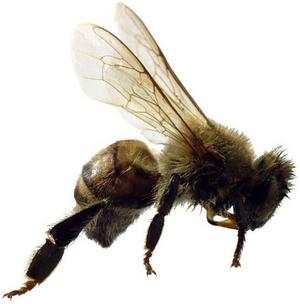
 This is the Africanized honey bee, better well-known as the "Killer Bee" and it lives up to its name. They are notorious for their lightning quick aggression, they are easily agitated and will chase their victim in swarm formation for up to a quarter of a mile away from their beehive. They look very much like the European honeybees, but one cannot tell upon looking, it takes a skilled eye, so extra precaution is forewarned. They have a negative impact on our honey industry because of their aggressive nature and are responsible for the deaths of some 1,000 people. When these Killer Bees attack, the only thing advised to do is run, as fast as you can, as far as you can and to avoid hiding under water. The bees will wait above the water until the person rises for air and then attacks them, these Africanized honey bees have longer periods of agitation than other species of bees. The government also understands that these bees are essential to our ecosystem, despite the negative consequences, they cannot be completely terminated, but they can be put under control with help from the public. Once again, the public awareness plays a big role, those who spot wild swarms are advised to report it and people are educated on how to avoid conflict and interaction with these bees in order to prevent injury.

Almost every country has an invasive species of some sort, and they cannot be overlooked, as their impact on the native environment could be a destructive one, but it is important that the governments and people find a middle-ground with these invasive species, they can't just "go away", but with patience and awareness they can be kept under control humanely.


Sunday, May 1, 2011

Saving the Great Barrier Reef

Mass coral bleaching evident across the globe
1.) A polyp looks like an upside down jellyfish and is the second stage of a Coral Larvae. Algae goes into the polyp and convert sunlight into food, allowing the polyp to grow and multiply. These colonies of polyp then form into Coral.
2.) Coral are very sensitive to change, like the increase of water temperature I
3.) Coral bleaching occurs when the coral becomes stressed, so the algae residing in it will move out - thus, the coral loses its main source of food. And color.
4.) Scientists believe coral bleaching is occurring now more than ever due to climate change.
5.) People can reduce their impact on climate change by turning off unused lights and appliances, avoiding unnecessary car rides, and reusing and recycling products as much as we can.
__________________________________________________________________________________

1.) The coral reef is home to 1,500 species of fish, 360 species of hard coral, 1/3 of the world's soft corals, 22 species of sea birds and 32 species of shore birds.
2.) Climate change is warming our oceans having negative impact on the Reef.
3.) Increased flooding pollutes the reef, so fish move to cooler, off-shore waters, which results in less food for  sea birds. 
4.) We can reduce climate change by buying environmentally sustainable products, opening windows instead of air conditioners, and drying clothes on a line.
__________________________________________________________________________________


1.) The benefits about using informative cartoons to educate children about the condition of the Great Barrier Reef are that they are cute and funny. They will definitely grab the attention of children so they learn. The drawbacks are that these are aimed only at children. In all truth, adults most likely have a greater carbon footprint than children, so adults should have something informative and attention-getting like this, but for adults. Lastly, by watching these shows, you are using energy. There should be more, local outdoor programs that directly benefit the environment.

2.) http://www.youtube.com/watch?v=sBQMMOT-Lj4 I feel that this video is a great for Native Australians because it is a newscast directly from the Australian government and research associations. It tells direct ways that Australians themselves can help the Great Barrier Reef to reduce coral bleaching and increase health.

3.) http://www.youtube.com/watch?v=__OVRtaWLt0 I feel this video is a great eye opener to those who don't hear about the condition of the Great Barrier Reef everyday, as opposed to Australians who may constantly be aware. Since foreigners are not there living alongside this Reef, they will have to help from afar, and by donating to funds that directly help the Great Reef, they ,too, can help.

4.) http://www.youtube.com/watch?v=w5-2WwFlL6Q This video is great for tourists expecting to travel to Queensland and experience the wonders of the Great Barrier Reef, only to surprised by the fact much of it is bleaching and dying. The video shows tourists having experienced just that and now feel the need to help the Reef they just swam in.

Saturday, April 30, 2011

Beyond the Reef


1.) The Great Barrier Reed is considered the "largest living structure on earth".
2.) Coral extracts Calcium Carbonate (CaCO3) from the surrounding waters to make solid tentacles.
3.) Red Algae could be considered the "glue" of the ocean, it cements fragments of shells, sand, and coral with sheets of CaCO3. It is responsible for much of the construction of the Great Barrier Reef.
4.) The Great Barrier Reef was established as a National Park in 1975.
5.) 33% of the Reef is protected from fishing.
6.) Scientists believe the current Reef is about 20,000 years old, although Geologists have found evidence of ancient corals believed to be half a million years old!

Are we trapped behind the lenses?

    
My aunt from behind the lenses while we
were touring the desert outside of Dubai


        While reading a reflective article, "Savor the Trip, Don't Tweet It" by Christopher Elliot, I actually found myself quite guilty of the things he was bringing out into the open. Elliot very generally points out the reality that we are living in a time where technology is openly available - everyone uses it. He makes the article less accusatory by also stating he and his family have also found themselves guilty of being engrossed in technology instead of the environment they were surrounded by, you're on vacation after all, who knows when this opportunity will arise again. By sharing his own personal experiences, I believe Elliot is trying to get to the reader to understand that technology doesn't need to run your travels. We aren't living in a Transformers movie,neither your phone, iPod nor laptop will suddenly transform into a robot and take control of you. It is by our own will that we allow ourselves to succumb to our technological desires, but by taking a break from it- we can learn to appreciate its absence.

       On this journey to Australia and New Zealand, I want to be absorbed, immersed; not into my friends' latest Facebook update, or the music playing from my iPod, but into the trip itself. Just I said before in response to Pico Ayer, we need to see with new eyes and take in every detail, use all our senses to live in the moment. That's not possible, when you're looking through the lens at the moment. As Don Mankin stated in Elliot's article "Instead of having the experience, you are now observing yourself having the experience. It's a layer removed and its just not as sensual." Those words couldn't be more true. It's great to document the experience, and have things to remember it by--as long as those things mean something to you and will continue to hold significance rather than if you were to pack it away and forget about it.
       Pico also brought up a point that I believe is relevant to Elliot's theme, the idea that fear gives value to travel. Fear is a driving force, that can push us to do unexpected things we might have not had the courage to do previously. Courage can only exist with the presence of fear, after all. On this trip, we must leave our fears behind. The fear of not being able to check our Facebook every hour. The fear of not being able to text friends. The fear of the unfamiliar. I've come to the realization I may never have this opportunity again and I want to do everything I can to make it worthwhile. I am going to loosen technologies tight grasp, I will bring my cell phone on this trip, solely because I used it as my iPod, but its use will be very limited. I will only use it to listen to music on the plane rides and in the hotel room, but that is the extent of its usage. I'm giving up Facebook altogether, I know for a fact it's going to be nothing but a burden. As for my camera- my one true love, it will be difficult but I plan on reducing the amount of video and photos I take by quite a bit. My goal is to take no more than 20 photos a day. That's a limit of 252 photos the entire trip, which will force me to only capture the moments that have the most significance to me personally. This isn't going to be me looking at my trip from among the mass of pictures. This is going to be me living the journey - each and every day, not from behind the lenses, but with new eyes.

Wednesday, April 27, 2011

History of the Human Condition

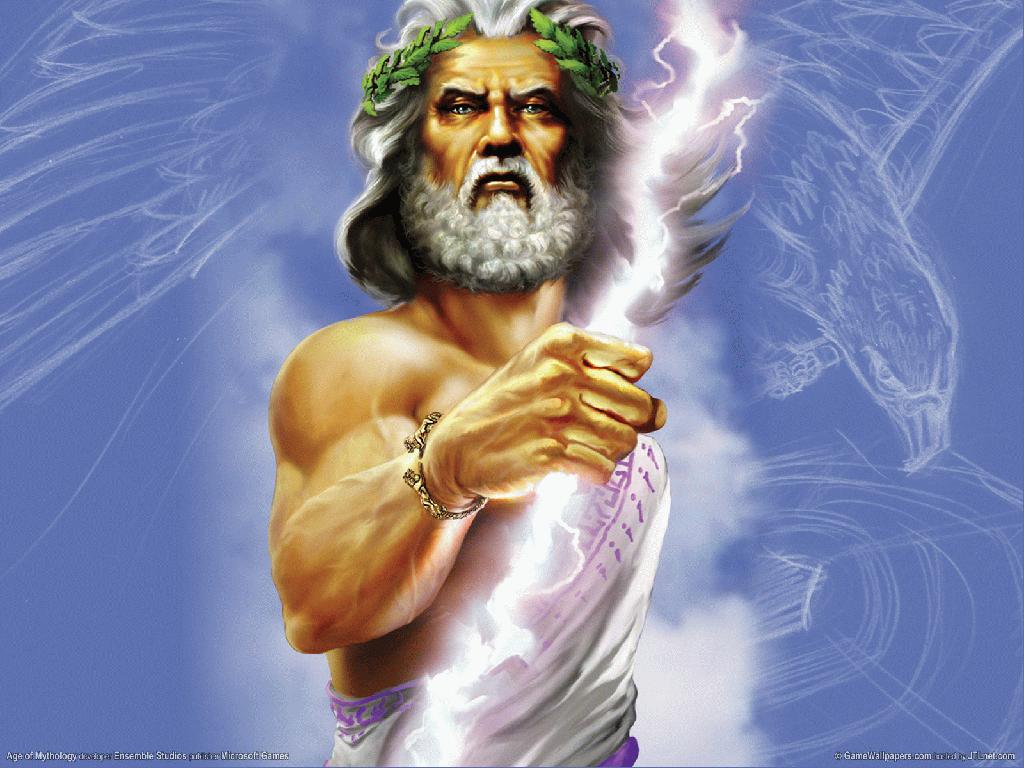
Zues: A famous figure in Greek mythology, a prime example of  
modern myth still shared  and kept alive.
We, as humans, have an undying thirst for knowledge of the unknown, a never ending supply of questions about everything that exists - or what is believed to be. Essentially, we are born in an abyss of ignorance and as we grow and evolve, we delve deeper into the abyss, we were not made to dwell in darkness, however. We are all in heavy pursuit of something greater. The pursuit of happiness. The pursuit of knowledge. The pursuit of freedom. And this endless pursuit is what gradually unveils the cloud of ignorance. This is the human condition. This pursuit is strengthened and kept alive by the existence of myths and creation stories, made to answer questions every human being asks such as "Why am I here?", "How did I get here?", "What is my purpose?", we rely on these myths and stories to fill in the blank spaces void of scientific explanation. These "myths" are more important than people may realize and they're all around. The Bible, for instance, dates back to the start of life, guidelines for a heightened self awareness and better life. And then, of course, are the stories we grew up with; Paul Bunyan, Johnny Appleseed, Greek Gods. Legends, stories and myths are necessary to maintain a strong culture, they need to be passed down and kept alive for those living in the present to know about where they and things around them originated. There are some things that can't be justified; proven, and that leaves us to trust what we believe. To trust the existence of the nonexistent.

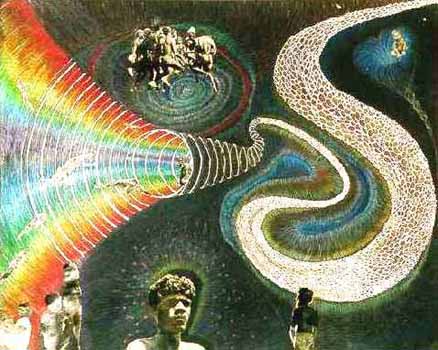
A portrait of the Aboriginal "dreamtime", heightened awareness and
connection of all living beings and earth
  The Aboriginal and Maori cultures have very creative and distinct values and beliefs when it comes to how their culture originated, although the stories have clear differences, they have a similar overall theme. Both stories hold deep significance in the structure of family and environment, both stories are based on an abundant amount of Gods, all being related, stress the importance of roles of  each member of the family. The Maori myth, for example, signifies complete trust in each member of the family, so that dishonesty and trickery against one another doesn't arise. Family should not turn on one another, no matter the extremity of the situation. The Aboriginal myth also stressed the importance of trust in one another, for example, when the living creatures of the earth saw the sun leave and feared she had abandoned them but when she reappeared "the children learned to expect her coming and going and were no longer afraid" because they trusted her. The Aboriginal myth also stressed the importance of living peace alongside family, so trivial matters such as greed and envy can be overcome. Although the stories do have the same general theme of the importance of family, the stories do differ when it comes to the "higher power" or center of the story. The Maori represent a strong relationship between the earth and human kind, humans being the superiors of the earth, exalted above animals, being the only early creatures mentioned to inhabit the earth at the time. This story focused more on social relationships and human interaction with one another and the effect it has on the earth, our actions directly effect our planet, the story seems to be void of environmental significance. The Aboriginal myth however, portrays a circle of life between all inhabitants of the earth and the earth itself, the sun being the mother of all life. The sun's presence stimulates growth in the environment and the creatures, who must work together to please the sun mother. The Aboriginal myth has a strong sense of environmental importance as well as social relationships. 


In today's high-tech, advanced society, it seems there is no need for these "myths" and "stories", after all, we have endless scientific evidence to back it up and explain everything. Right....and wrong. Science can only explain so much, there are, undoubtedly, unexplainable happenings that we as humans seek a reasonable explanation for, and when science falls through, the stories that have existed for generations seem to aid us with their different perspectives on the way things are, but it seems society is quick to outgrow these "childish" stories. It reminds me of when I was younger, stories of Santa and his elves, and the water and carrots I would leave outside for the reindeer. Santa was the only logical explanation for the presents left under the tree the next morning, but I soon outgrew this belief, because like most people I sought out the truth, but I never truly "outgrew" this story. There is something deeper in these myths and stories - there are morals and lessons behind them, I learned the importance of giving for the sake of giving, to not expect anything in return, the importance of friends and family, and compassion. This is what the ancestors of the Aboriginal and Maori have left behind for us in these stories - lessons for the present and the future, the presence of environmental involvement in these stories may signify that we need to treat our environment with the utmost care, in an almost sacred manner, we may be superior beings, but with that comes power, the power to change the earth - the Maori and Aboriginals believe we can change it for the better, but because the world today is not as in tune with stories and culture such as these, our environment has become a business deal, something to make money off of, not something to cherish and protect. Which brings us back to the importance of family structure. Without compassion, trust and discipline, trivial matters such as greed and violence which are always present, but can be controlled, can spiral out of control.

 Creation "stories" are still ever present and I am an avid believer of one myself. The Bible keeps me rooted to my beliefs and the way I treat others and look at the world around me. My faith has led me through struggles and taught me that the obstacles that I encounter are not meant to knock me down, but to help me build resistance against them so I can overcome them. As a Christian, I have accepted the fact that I am not perfect and never will be, but I am made exactly the way I am for a reason, and my faith has helped me accept myself and others' differences. Because I know I am not perfect, and can strive to be the best that I can, and accept and learn from the mistakes I make along the way because I know it will only strengthen me. Having faith in God has taught me to believe in everything I do, no matter how insignificant because I know I am never alone. The way I treat others also directly attributes to my beliefs, I just remember that the way I treat others is the way I treat God, so everyone deserves respect, differences aside, because in the end, we are all part of life's creation story.

Saturday, April 16, 2011

A Glance into the Past, Three Countries' Journey to the Present


We live in a big world. Albeit, with the ever growing modern technology we possess, it seems to be growing smaller, but it's still the same size it's always been. It's history, however, is tremendously colossal and significant, the earth's modern day humans having been bustling about for around 200,000 years. And they've left behind immalleable footprints. Some such footprints withhold similar significance and history behind them, such as those of the Aboriginal Australians, New Zealand's Maori, and early American settlers. In order to fully appreciate a country in its present state, you must be cognizant of its past. A tree cannot grow without its roots firmly planted. A driver cannot not drive without glancing at the rear view mirrors. We, as people cannot understand the present nor embrace the future without glancing into the past.
               Around 1770 A.D for all three (present) countries underwent a period of exploration and discovery by the Europeans, three unknown lands with much to offer and learn about. After a long treacherous sea-faring journey, British navigator, James Cook arrived in New Zealand in 1769, welcomed by the land's harsh beauty. Cook documented profusely in journals of his discovery, and upon the arrival in New Zealand, he wrote "The land on the Sea-Coast is high with steep cliffs, and appeares to be cloathed with wood and Verdure". These precious journals he kept inspired other Europeans to also explore this extraneous land. A year later, James Cook ventured to Australia and claimed it as New South Wales, the first of six colonies in 1788. At this time in America, rebellion was stirring in the form of the Boston Tea Party and the publication of The Intolerable Acts, America was striving to find itself, to unite itself, thus the 13 colonies were created. Much similar to Australia perhaps, 11,000 miles away both America and Australia were transforming into the strong nations they are today. 
Having been continuously productive and ambitious, the Europeans were on a conquest for domination, even if it meant hurting others in the process. Thus, creating similar signifigant controversy in America. 1838, the year the Cherokee walked the Trail of Tears, and as a result many died on the treacherous walk. The Europeans saw no benefit from colonizing the Americas with the Native culture still present, so they brutally forced the Native Americans onto reservations, out of sight, out of mind. New Zealand and America may have been completely different countries, but they were suffering together. There is, however a brighter side to this past. The Gold Rush of 1850-1860 couldn't be a more perfect representative of opportunity and wealth, and all three countries had the chance to experience it. In Australia, whole settlements up and left in search of gold. In New Zealand, gold was discovered in Tuapeka, and indeed a gold rush ensued. In America, an event that would forever mark the history books, The California Gold Rush, which brought approximately 200,000 "forty-niners" to California in search of gold! Unfortunately, many returned home empty-handed, and many Native Americans in California at the time died because of this sudden immigration, but the Gold Rush undoubtedly changed American, New Zealand, and Australian History in its effects.
      The 1900s was a time of independence, unity and self-discovery for these countries, and all three have battle wounds to show the previous struggle. Early in the century, Australia's 6 colonies have been conjoined to create The Commonwealth of Australia in 1901. Just 6 years after, New Zealand becomes a dominion within the British Empire, and are on their way to independence, which they later receive in 1947. 1955-1962 was a critical time period of signifigant movement towards equality for both Australia and America. America was introduced to one of the world's most profound leaders, Martin Luther King Jr and the dream he had for the future of America, a future of colorless prejudice, and through him, African Americans gained the equality they should've always had. For the Aboriginals, they were given the right to vote and in 1967 they were recognized as citizens of Australia. The Aboriginals made leaps and bounds after that, in 1976, the Aboriginal Land Act was passed, allowing them to make claims on ancestral land.Both of these feats represent how far having a dream can take a person, or in fact, a nation. All three countries had a dream, and acting upon that dream, they achieved what they had hoped for, separately, yet together. Even today, these countries continue to grow and achieve, the long-awaited formal apology was finally given to the Aboriginal people by the Australian Parliament in 2008.
.
"Australia" my all-time favorite movie, which is actually about 
the Stolen Generation and the Aboriginal culture
during World War II.

I have never been to Australia or New Zealand,they are both foreign and unknown to me,  but by learning their history and comparing it with the history of my nation, I will come to realize, despite our differences, we all struggle together, we feel the same emotions, we live on the same earth and we all have to carry our pasts with us -always.


Sources:

Sunday, January 23, 2011

Pico Iyer, quite simply my new inspiration.


          Pico Iyer's views on travel are inspiring and refreshing. He humbly, yet sophisticatedly breaks down the complex idea of travel and reduces it to terms everyone can relate to. His writing style even represents his generalistic standpoint on travel, Pico believes everyone perceives the places they travel to differently, and he allows his writing to be digested the same way -- "Why we travel" was a journey through my mind on how I perceive travel. He allows this reading to be perceived by everyone differently, and this is travel through my eyes.


          My reasons for traveling align very closely with Pico, I may not be able to word it as seamlessly and beautifully as he does, but this is about accepting differences. I presume we travel....to believe. We, as humans are highly interactive and complex, and each of us has a desire for something more. We all want to know what our place in this world is, or simply what makes up the world, what is out there? It's a big world, but it's growing smaller and smaller with technology. However, that doesn't stop anyone from traveling. But, back to my point. I agree with Pico that "traveling is a way to reverse time, to a small extent, and make a day last a year...and traveling is an easy way of surrounding ourselves, as in childhood, with what we cannot understand." We have all wanted to go back in time, relive a moment, change past actions, take back words, be young again. With travel, it allows that childhood belief,  complete trust and oblivion to live again. Travel is believing. What a person chooses to believe is up to the individual, but traveling in belief of something is immersing yourself in something completely new...with your eyes closed. And by allowing your eyes to be closed, you allow your mind to be open. You allow your mind to be free of prejudice and judgement. Travel is unbias. Travel is opportunity. Travel is freedom. Travel is endless. To travel is to believe.


         Iyer says "The real voyage of discovery consists not in seeing new places, but in seeing with new eyes"
It's a widely used phrase, it's so simple, yet it means so much. To me, to see with new eyes, is really like what I mentioned earlier, to "see" with your eyes closed. Release previous ready-judgement and allow yourself to really see. To see with new eyes is not to look at things from your point of view, or any view in general. But to actually just observe. Take in every detail, every little detail, because you cannot see the whole picture unless you see everything that it is composed of. And once you have observed, you make importance of what's in front of you, around you, decide what it means to you, attach meaning to it, and that is when you truly see. And I can guarantee, you'll never see it the exact same way ever again. I can relate this to movies, let's use Inception for example, the first time, I was really trying to understand it all, I was trying to observe every detail, to make sense of what was happening. It was not until the second time that I watched the movie, did I realize that I was looking for all the wrong details. And that was my mistake, looking for the details, I had set myself up, unintentionally for certain parts of the picture, focusing on the parts I  thought were important, when really all of them were. The picture below can be a visual example of seeing with new eyes. It's a mixture of colors, maybe your eyes will automatically drift to your favorite color. If you're seeing it with new eyes, you'd look at all the colors, because they are all beautiful and equally as important.


Iyer also makes a point by saying "What gives value to travel is fear." Fear is something we obviously don't like to feel, fear is such a powerful, driving force, but fear is actually not all bad. Fear can lead us to do things we wouldn't normally do (I say this in a good sense), fear can be the push from behind that at times we all need. As Rosalia de Castro once said, "I see my path, but I don't know where it leads. Not knowing where I'm going is what inspired me to travel it." People normally have a fear of the unknown, of instability, of lack of structure or routine. But in order to get the benefits fear can offer, you must dive right into the center of it. We have a natural curiosity for the unknown, but it is often hindered by the presence of fear. On this trip, we will leave our fears behind and travel through the days, not to be held back by our previous restraints, because the  "only thing to fear is fear itself." It is better to be free to experience what you will.

And as for Iyer relating travelers to "human carrier pigeons", transporting ideas and culture from one society to another, I completely agree. As travelers we have all this freedom and excitement, but we also have a very important responsibility. To share what we have seen and experienced to anyone who has the ears to listen. Like Iyer mentioned, in some impoverished places in the world "we are the eyes and ears of the people we meet, the only contact with the world outside..." It is our job to share our knowledge with others, spread culture, and allow them to also see the world holistically. To allow them to believe. Because for those haven't and never will travel, their belief is the only thing they have as evidence of the outside world.

 "And if travel is like love, it is, in the end, mostly because it's a heightened state of awareness, in which we are mindful, receptive, undimmed by the familiarity and ready to be transformed. That is why the best trips, like the best love affairs, never really end." 

I chose this as my favorite quote because to me personally, it really does describe the effect traveling has on body and soul. We travel to renew, refresh, awaken parts of us that have long been asleep. I can especially relate, remembering when I went to Italy, visiting family in the mountains in Tuscany, and I was in a mood I had never experienced before, a sense of complete serenity and homeliness, and up until then, it had been dormant. Traveling awakens you. And it does make us aware and alert, every time you travel, something about your journey with stick with you - forever, and soon it surrounds and includes itself in your everyday life, much like love, a love that that is neverending. Travel is unbias. Travel is opportunity. Travel is freedom. Travel is endless.


Monday, January 10, 2011

Hello, nice to meet you.

I guess telling you my name would be a good place to start off the beginning of....simply, the greatest adventure of my life. My name is Amanda, I'm a sophomore at Grayslake North, nice to meet you. Okay, that wasn't so hard, let me tell you a bit about myself. Traveling in itself isn't a new adventure to me, growing up in a military family, relocating happens often, starting very young. And I wouldn't have it any other way, traveling has made me culturally ambiguous, very open-minded and accepting. In my spare time, I practically eat, sleep, breath Theatre. That's my number one passion besides traveling. I like to write, horse back ride, love animals/environment and I'm always listening to music. And this summer I'm traveling across the world.


        The reason I signed up for this course is because it's something I've never done before, and something I will never be able to do again. Yes, I plan to visit Australia and New Zealand again sometime in the future, but it won' be the same as this particular trip. When, in high school, am I going to be able to go across the world with with school peers and experience something totally new and foreign like this? Never, so I knew I had to sign up. Plus, look at the picture above, who wouldn't want to see something that beautiful?
         What I hope to learn from an opportunity like this is to strengthen my ability to see "the big picture" We played a game in class yesterday that challenged us to not look at what the teacher wanted you to see, it's a distraction, the goal is to imitate the actions before and after the initial distraction. Well, let's say I got distracted...so that inspired me to make sure that when I arrive in New Zealand and Australia, to look and appreciate everything, even the little things. Because the little things add up to something bigger.


        The thing that specifically interests me about Australia and New Zealand is its natural beauty. It's not just the outside beauty, I think the Aboriginal culture is very precious and humble, and I admire its ability to strive despite the very rough obstacles the Aboriginal culture had to defeat in the past. I also admire the way New Zealand is so in-tune with their environment, everywhere you look, it seems the earth is radiating with beauty, the grass really is greener on the other side. I love its diverse environment, the geysers, mud pools, mountains, hills, oceans, the exotic animals and the fact that there are parts untouched and unharmed by humans. It's pure. I also find it interesting that New Zealand is practically overflowing with sheep :)
      
        To conclude, I believe learning about where you're going before you go is important because oftentimes people will just pack up and travel somewhere new to them. They'll either have a great time because by chance everything just works out in their favor or they'll be quite miserable and return home wishing they'd done some planning. I think it'd be very overwhelming to be in a foreign place with so much to offer...but not have a clue about any of the great things you can experience. I believe, if you go somewhere and know everything there is to offer, and know about the traditions, and customs you'll connect much more personally to the trip if you'd done the opposite because you immerse yourself into their lifestyle. In addition, if you don't learn about the social norms of another country, what behavior is accepted and what's not, you could find yourself extremely embarrassed or worse... in big trouble.